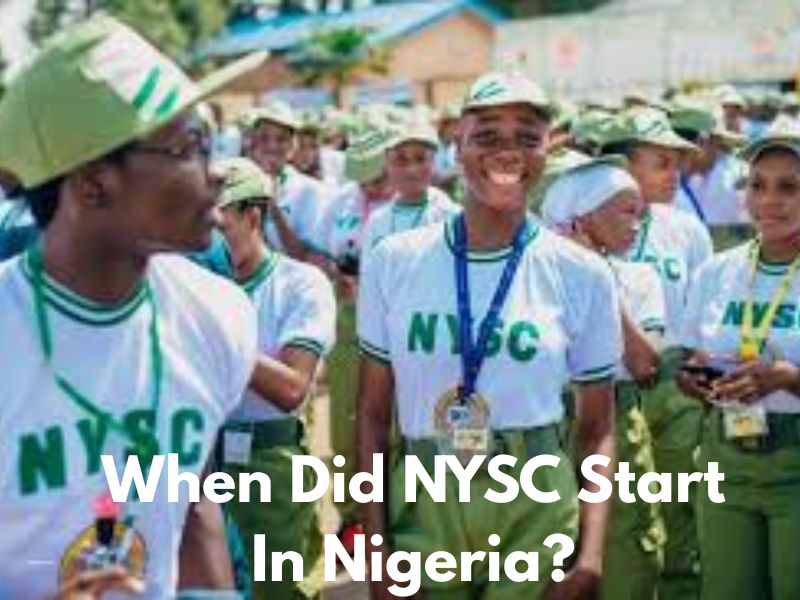
When Did NYSC Start In Nigeria? The National Youth Service Corps (NYSC) officially started on 22 May 1973 when General Yakubu Gowon signed Decree No. 24 of 1973. The first orientation camps opened a few weeks later in June/July 1973, and the pioneer Batch A passed out on 20 June 1974. That single decree launched what has become one of Nigeria’s longest-running and most impactful national programmes.
Why NYSC Was Created: The Real Reason Behind the Scheme
When the Nigerian Civil War ended on 15 January 1970 with the surrender of Biafra, General Yakubu Gowon famously declared “No victor, no vanquished” and announced the 3Rs policy: Rehabilitation, Reconstruction, and Reconciliation.
But fine speeches alone could not fix the damage.
Millions of Igbo people who had fled the North and West during the 1966 pogroms were afraid to return. Northerners still feared “Igbo domination.” Westerners worried about being caught in the middle again. Markets, schools, and families had been torn apart. Trust between ethnic groups was almost zero.
By 1971–1972, universities were reopening and producing fresh graduates. Many of these young people had grown up hearing only one side of the story from their parents, teachers, or local radio. Some Northern graduates genuinely believed that every Southerner was a potential rebel. Some Southern graduates saw every Northerner as a bloodthirsty soldier. A whole generation was at risk of inheriting the hatred of the war.
Gowon and his close advisers — people like Chief Obafemi Awolowo, Anthony Enahoro, Allison Ayida, and Brigadier Olusegun Obasanjo (who accepted Biafra’s surrender) — knew that lectures about “one Nigeria” would not work. They needed something that would force young people from different backgrounds to live together, depend on each other, and see that the stereotypes were false.
So they borrowed ideas from similar programmes in Ghana (National Service Corps), Israel (military and civilian service), and the United States (Peace Corps), but made it compulsory and nationwide.
The thinking was very practical:
- If a Yoruba doctor from Lagos spends one year teaching in a village school in Sokoto, he will learn Hausa words, eat tuwo, attend Sallah, and realise that Northerners are ordinary human beings.
- If an Igbo engineer from Enugu is posted to a hospital in Kano, he will work side-by-side with Hausa nurses and see that the North is not full of “born-to-rule vampires.”
- If a Tiv or Ijaw graduate serves in Oyo or Benin, they will bring new ideas home and take new friends with them.
In short: force proximity, and prejudice will reduce.
The war had also destroyed roads, schools, and hospitals, especially in the East. Fresh graduates — teachers, doctors, engineers, agriculturists — were the quickest way to send skilled hands to those places without waiting for slow government hiring.
That is why the decree deliberately said corps members must be posted outside their geo-political zone and state of origin (a rule that is still strictly followed, except for marriage, health, or serious health cases).
The five official objectives written in 1973 were not just fine words — they were the exact medicine the country needed at that moment:
- To foster national unity → by making sure no one serves at home.
- To promote understanding of other cultures → you cannot hate a language you now speak small-small.
- To help reconstruct war-torn areas → many of the first corps members were sent straight to the former Eastern Region.
- To encourage reconciliation → when you share the same plate of food in camp, old wounds start healing.
- To develop rural areas → teachers in village schools, agricultural officers showing farmers new methods, doctors in general hospitals — all came through NYSC.
More than fifty years later, you can still open any NYSC handbook or visit the website and see those same five objectives printed word-for-word. Very few government programmes in Nigeria have kept their original mission so faithfully.
In the end, NYSC was never just about “one year service.” It was — and still is — Nigeria’s biggest and longest-running peace-building project disguised as youth service.
The Pioneer Batch: How It All Began in 1973/1974
In 1973 Nigeria had fewer than twelve universities, so only 2,364 graduates were mobilized for the very first set. Many of them travelled for the first time by train, night bus, or “mammy wagon” to states they only knew from geography class.
There were no permanent orientation camps yet; temporary venues like the former Man O’ War Bay in Lagos and other make-shift locations were used. The excitement was electric — these young people saw themselves as nation-builders helping to stitch Nigeria back together after the war.
How NYSC Has Changed Over the Years
What started as a post-war healing programme has evolved in many ways:
- From only university graduates to include polytechnic and now monotechnic graduates
- From paper registration to fully online mobilization and call-up letters
- From one batch per year to three or four streams because of rising graduate numbers
- From temporary camps to permanent, modern orientation camps in every state and the FCT
- From purely public-sector posting to allowing service in private companies and NGOs
- From just community service to adding Skills Acquisition and Entrepreneurship Development (SAED) since 2012
Even with regular debates about security, relevance, and calls to make it optional, NYSC remains compulsory for anyone who wants to work in government or most formal private organisations.
Conclusion: When Did NYSC Start In Nigeria?
NYSC began on 22 May 1973 because Nigeria needed its young people to see, touch, and live the reality that we are one country. More than five decades and millions of corps members later, it has become much more than a government policy — it is a national rite of passage.
Countless friendships, businesses, and even marriages that cross ethnic lines started with “Where were you posted?” The scheme is not perfect and must keep adapting, but very few programmes have done more to quietly hold Nigeria together. As long as young Nigerians keep meeting one another in far-away states wearing the same khaki and jungle boots, the dream that began in 1973 lives on.